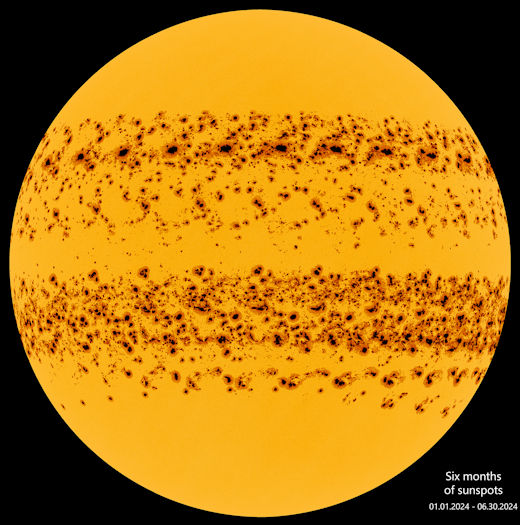
As the old saying goes, ‘A picture is worth a thousand words’, and this latest photo compilation of the solar activity of just the first six months of 2024 says a lot! As I perceived in early February 2024, “It’s going to go fast now”, and it certainly has been. Much, much more to come so rest when you can because it’s going to go fast now for the next few years. I’ll get into this and more in other articles. For now, cope with the accelerated and amplified solar Light energies and all the higher-level evolution packed in them as best you can. Another article up soon.
Denise Le Fay
July 1, 2024
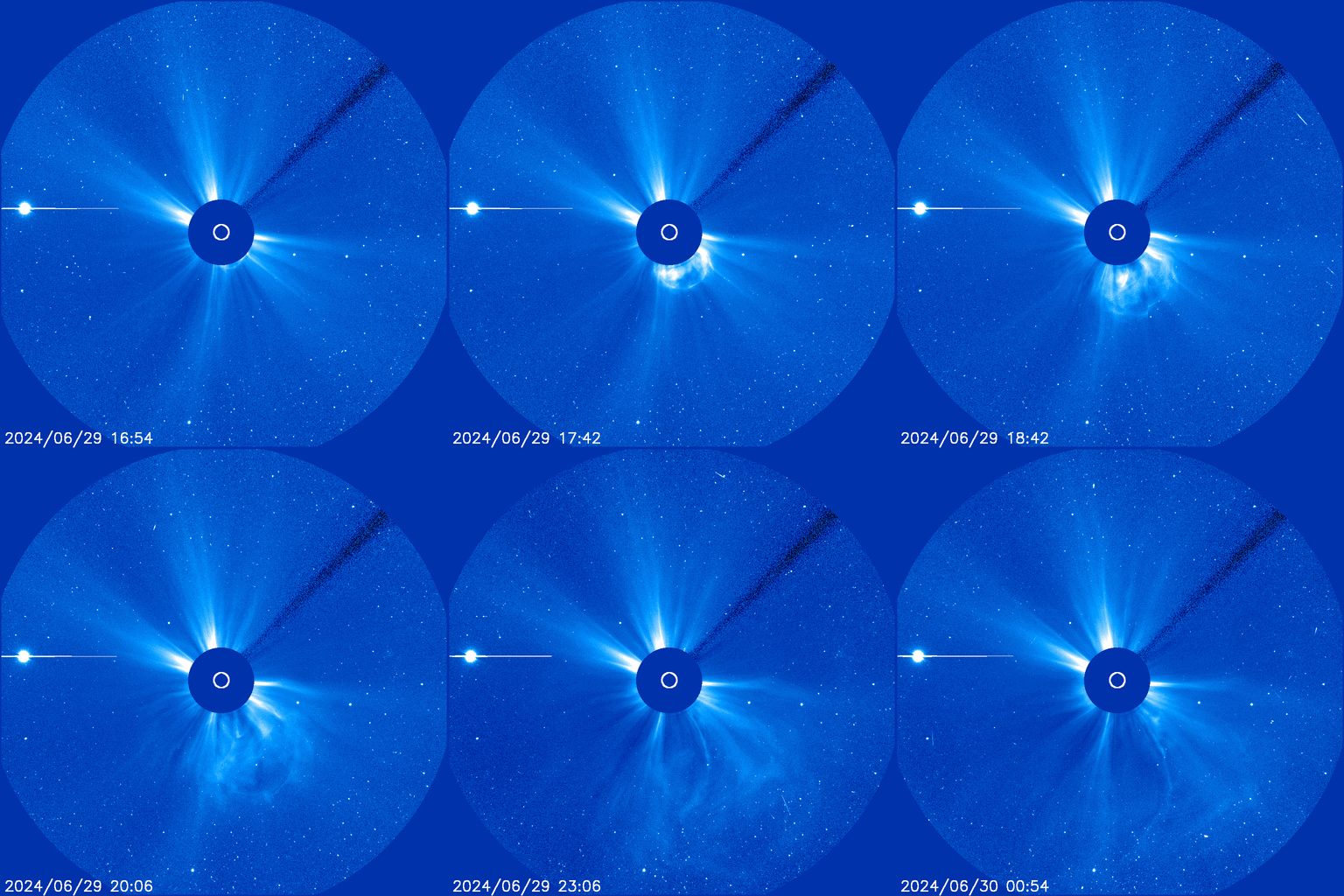
“GLANCING-BLOW CMEs: Two to three CMEs, which left the sun over the past few days, are expected to graze Earth’s magnetic field on Jul. 1st through 3rd. The most effective hit will probably come on July 3rd from this CME, hurled into space by a magnetic filament eruption in the sun’s southern hemisphere. Minor G1-class geomagnetic storms are possible before the 4th of July. Aurora alerts: SMS Text
IT LOOKS LIKE SOLAR MAX: The first six months of 2024 are in the books. Amateur astronomer Eduardo Schaberger Poupeau stacked daily sun images for all 182 days, and it looks like Solar Max:
“Since the beginning of 2024, the sun has increased its activity,” says Poupeau. “The presence of so many sunspots is a clear indication that we are close to the maximum activity of Solar Cycle 25.”
This composite image shows us two things. First, sunspots are concentrated in two bands, one north and one south of the sun’s equator. As the solar cycle unfolds, these two bands will converge on the equator, eventually meeting and extinguishing themselves in a collision of opposite-polarity magnetic fields. Solar Maximum will be replaced by Solar Minimum.
Second, the southern hemisphere is spottier than the north. This is not unusual; sometimes one hemisphere dominates the other for months at a time. In this case, sunspot counts were skewed by one massive southern sunspot (AR3664), which circled the sun three times, tripling its contribution to the southern total.
Solar Max is far from over. Forecasters expect it to persist for 2 to 3 years, and we are just getting started. Stay tuned!”
 HighHeartLife